
Architecture Before Acceleration
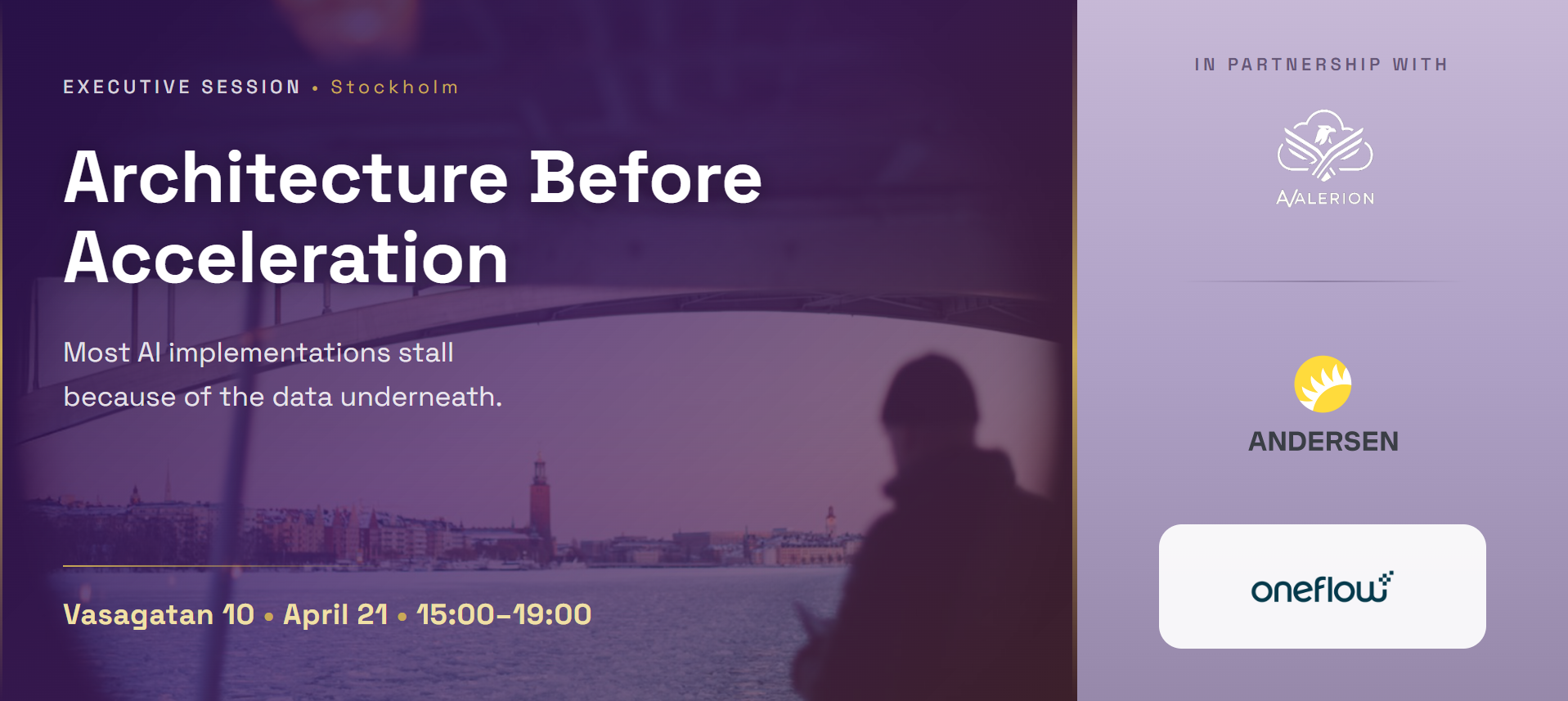
Architecture Before Acceleration: Why Data Structure Is the Real Bottleneck for AI Success
There is a pattern emerging across organizations in the Nordics that have invested heavily in Salesforce AI tools over the past twelve months. The technology works. The demos were compelling. The implementation completed on time. And yet, three months later, the results have plateaued.
Agentforce is not performing the way the roadmap suggested. Data Cloud is live, but the unified customer view is still fragmented in practice. The AI layer is in place, but the business outcomes it was supposed to unlock remain out of reach.
In almost every case, the diagnosis is the same: the problem is not the AI. It is the architecture underneath it.
This is the conversation that Architecture Before Acceleration, an in-person executive session hosted by Avalerion, Andersen, Oneflow and Salesforce on April 21, 2026 in Stockholm, is designed to have.
The AI performance gap: what is actually happening in Nordic organizations
Nordic companies are among the most digitally mature in the world. Sweden, Denmark, Norway and Finland consistently rank among the highest globally for technology adoption and digital infrastructure. And yet, when it comes to enterprise AI, the performance gap between expectation and outcome is striking.
A significant portion of organizations that have deployed AI tools within their Salesforce environments report that results fell short of projections within the first six months. The reasons cited most frequently are not technical failures. They are structural ones: data quality, system fragmentation, unclear ownership, and the absence of a unified data model before the AI layer was added.
The issue is architectural and it was present long before the first line of Agentforce configuration was written.
Salesforce's own research consistently points to the same root cause: organizations that achieve the highest ROI from AI tools are those that invested in data unification and governance before deploying AI features not simultaneously, and certainly not after.
In the Nordics, where enterprise technology adoption is fast and board-level AI mandates are now common, the pressure to move quickly has outpaced the structural preparation in many organizations. The result is a cohort of companies that are technically running AI, but not yet realizing its full commercial potential.
Why Agentforce depends on your data architecture
Salesforce Agentforce is one of the most significant product developments Salesforce has released in a decade. It enables organizations to deploy AI agents across sales, service, marketing, and operations, agents that can take action, make recommendations, and automate workflows at a scale that was previously impossible.
But Agentforce is not a standalone capability. It operates on top of your Salesforce data model. It draws from Data Cloud to access a unified customer profile. It acts on the objects, relationships and records that exist within your CRM.
Which means it can only be as good as what it runs on.
What happens when the data layer is fragmented
When organizations have inconsistent data models, duplicate account records, conflicting field conventions, siloed data sources that have not been unified into Data Cloud, Agentforce encounters the same structural problems that any downstream process would. It does not have a reliable picture of the customer. It cannot make accurate recommendations. It takes actions on incomplete context.
The specific failure modes are predictable:
Duplicate and conflicting records: Agentforce agents acting on duplicate contact or account records produce inconsistent outputs and erode trust in the AI system.
Missing relationships: When standard Salesforce objects have not been properly related, accounts to contacts to opportunities to cases, Agentforce cannot understand the full customer journey.
Ungoverned custom fields: Organizations that have accumulated years of custom field sprawl without documentation or ownership create an environment in which AI models cannot reliably interpret data meaning.
Data Cloud unification failures: If the identity resolution in Data Cloud is incomplete or inaccurate, the unified customer profile that Agentforce relies on will be wrong, at scale.
These are not AI problems. They are data architecture problems. And they require architectural decisions to resolve.
The four structural decisions that come before AI deployment
Organizations that are successfully scaling AI within Salesforce have made four structural decisions before deploying AI features. These are not technical decisions, they are leadership decisions, and they belong in a room with executives and senior decision-makers, not just architects.
1. Data unification strategy
Before Agentforce or Data Cloud can deliver value, your organization needs a clear and implemented strategy for unifying customer data across systems. This means deciding which systems are sources of truth for which data types, how those systems connect to Salesforce, and how conflicts between data sources are resolved.
This is not a one-time project. It is an ongoing operational commitment, and it needs executive ownership.
2. Data governance and ownership
AI systems amplify whatever is in your data. Clean, well-governed data produces trustworthy AI outputs. Poorly governed data produces confident-sounding AI outputs that are wrong.
Governance means defining who owns each data domain, what standards apply to each object and field, how data quality is monitored, and what happens when quality falls below acceptable thresholds. It requires clear accountability at the organizational level, not just technical documentation.
3. Object model and architecture review
Most Salesforce environments that have been in use for more than three years carry structural debt: custom objects that were built for specific use cases and never rationalized, field proliferation without documentation, process automations layered on top of each other. Before adding an AI layer, this architecture needs to be reviewed and — where necessary — restructured.
This is where a Salesforce consulting partner in the Nordics adds the most value: not just building new capabilities, but ensuring the foundation can support them.
4. Contract and operational architecture alignment
AI does not operate in isolation. In organizations using Salesforce, the AI layer intersects with contract processes, approval workflows, customer communication cadences, and operational decision-making. How these processes are architected — and how they connect to the data model, determines whether AI automation actually accelerates outcomes or introduces new complexity.
This is a dimension of AI readiness that is rarely discussed at the executive level, but it is consistently where implementation friction surfaces. It is one of the reasons Oneflow is part of the Architecture Before Acceleration conversation.
What AI-ready organizations in the Nordics are doing differently
The organizations in Sweden and the broader Nordics that are delivering measurable, compounding results from Salesforce AI share several observable characteristics:
They treated data architecture as a strategic initiative, with executive sponsorship, defined milestones, and dedicated resources, before beginning AI deployment.
They made Salesforce Data Cloud a prerequisite for Agentforce, not an add-on after the fact. They invested the time to complete identity resolution, build calculated insights, and validate the unified customer profile before activating AI agents.
They defined clear governance structures: named data owners, documented standards, and operational processes for maintaining quality as the business scales.
They chose Salesforce consulting partners with architectural depth — partners who could assess and restructure the data foundation, not just configure new features on top of an existing environment.
And critically — they brought these conversations into the boardroom and the executive team. They treated AI readiness as a strategic question, not a technical one.
Architecture Before Acceleration — the Stockholm executive session
On April 21, 2026, Avalerion, Andersen, Oneflow and Salesforce are bringing together C-level executives and senior decision-makers in Stockholm for an in-person session built around exactly this conversation.
Architecture Before Acceleration is a half-day executive session at Vasagatan 10 in central Stockholm, running from 15:00 to 19:00. Attendance is complimentary for qualified participants. Seats are limited.
Session agenda
The agenda is structured to balance expert-led sessions with peer conversation, because the most valuable insights often come from the room, not just from the stage.
Arrival and welcome (15:00) Registration, introductions, and initial peer networking.
Opening and executive framing Why architecture, not AI, is the defining factor for scalable performance. What the data says about where Nordic AI deployments are succeeding and where they are stalling.
Andersen: Agentforce + Data Cloud, Why Data Architecture Defines AI Success Presented by Nick Zenko (CTO, Andersen) and Hleb Mazheika, this is the technical and strategic heart of the session. What does a data-ready Salesforce environment actually look like? What does the path from fragmented architecture to AI readiness involve? What are the most common structural mistakes, and how are they corrected?
Moderated town hall: What defines AI readiness? An open, facilitated discussion on governance frameworks, data ownership models, and organizational alignment. Structured around questions from the room — not slides.
Oneflow: Contract Architecture and Execution Tobias Haraldsson, Head of Global Partnerships at Oneflow, on how contract infrastructure connects to AI-driven operations at scale, and why contract architecture is often the missing link in AI readiness discussions.
Roundtable discussions: Scaling AI success across organizations Peer-led tables on specific themes: data governance models, Data Cloud implementation decisions, Agentforce deployment sequencing, and organizational change management. This format consistently produces the most useful conversations — and is why attendance is limited to senior decision-makers.
Networking and close (19:00) Key takeaways, continued conversations, and close.
Speakers
Alexander Isik: Director of Operations, Avalerion Alexander leads operations and client engagement at Avalerion, working with organizations across the Nordics on Salesforce platform strategy, implementation, and scale. LinkedIn
Nick Zenko: Chief Technical Officer, Andersen Nick brings deep Salesforce architecture expertise to the conversation on Data Cloud and Agentforce readiness. His session addresses the structural decisions that determine whether AI deployments deliver. LinkedIn
Hleb Mazheika: Partnerships, Andersen Hleb works at the intersection of Salesforce partnerships and enterprise implementation, with particular focus on Data Cloud adoption across European markets. LinkedIn
Tobias Haraldsson: Head of Global Partnerships, Oneflow Tobias leads Oneflow's global partnership strategy, with deep expertise in how contract infrastructure connects to sales operations and AI-driven execution at scale. LinkedIn
Who should attend
Architecture Before Acceleration is designed for C-level executives and senior decision-makers in organizations that are evaluating, planning, or actively deploying AI within a Salesforce environment.
You will get the most from this session if:
You are a CEO, CTO, CRO, CDO, or VP-level leader responsible for technology or commercial strategy
Your organization is using or investing in Salesforce Sales Cloud, Data Cloud, or Agentforce
You are navigating the question of AI readiness and want a peer-level, expert-facilitated conversation about what it actually requires
You are based in Stockholm, the broader Nordics, or the UK and want to connect with peers making the same decisions
This is not a product demonstration and it is not a sales event. It is an executive-level conversation about the decisions that come before the technology and that make the technology work.
Attendance is complimentary. Seats are limited.
Event details
Date Tuesday, April 21, 2026
Time 15:00 – 19:00 (CET) Olof Palmes gata 11, Stockholm
Format In-person executive session
Hosted by Avalerion · Andersen · Oneflow · Salesforce
Audience C-Level & Senior Decision-Makers
Cost Complimentary (registration required)
Frequently asked questions
Who is Architecture Before Acceleration designed for? This event is designed for C-level executives and senior decision-makers, including CEOs, CTOs, CROs, and VP-level leaders at organizations that are using or investing in Salesforce Agentforce, Data Cloud, or AI-driven automation. It is specifically structured for decision-makers, not technical implementers.
Is the event free to attend? Yes, attendance is complimentary for qualified participants. Registration is required and seats are limited. The session is hosted at Vasagatan 10 in Stockholm on April 21, 2026 from 15:00 to 19:00.
What will attendees learn at the Stockholm AI event? Attendees will gain a clear understanding of why data architecture is the defining factor for Salesforce Agentforce and Data Cloud performance, and what structural readiness actually looks like. The session covers Data Cloud implementation, AI governance frameworks, contract architecture, and includes peer roundtable discussions on scaling AI across organizations.
Why is data architecture so important for Agentforce? Agentforce operates on top of your Salesforce data model and uses Data Cloud to access a unified customer profile. When the underlying architecture is fragmented, with inconsistent data models, duplicate records, or incomplete Data Cloud unification, Agentforce cannot produce reliable outputs. The data layer is not a technical detail; it is the strategic foundation for all AI performance.
What is the difference between Agentforce and Data Cloud? Data Cloud is Salesforce's customer data platform, it unifies data from multiple systems into a single, real-time customer profile. Agentforce is Salesforce's AI agent framework, it enables automated, intelligent action across sales, service, and marketing workflows. They are designed to work together: Data Cloud provides the unified data layer that Agentforce acts on. Without a properly implemented Data Cloud, Agentforce is operating on incomplete information.
Where is the event located in Stockholm? The event takes place at Vasagatan 10, 111 56 Stockholm. A central Stockholm venue within walking distance of Stockholm Central Station. Doors open at 15:00 on April 21, 2026.
